It’s been 25 years since Lisandro Alonso’s La Libertad. This fact has been frequently repeated when discussing Double Freedom, a sequel (remake?) to the 2001 film that left a distinct footprint in its corner of cinema. It also feels like an important one to mention – the passage of time needs to be brought up because, in the first frame of Double Freedom, the continuation of a story feels less striking than the mark of time itself. Mirroring the bookends of La Libertad, Misael sits next to the fire, eating armadillo meat with his knife, the camera panning up and down; thunder flashes behind him; it’s like nothing has changed in these 25 years and his nightly ritual has never been disrupted. But the mirror reflects one thing: age- more wrinkles on his face and a bigger belly – the eeriness of watching the strange object that is La Libertad – the finest constructed, closed-off fictional spaces this century – returns. As the film continues and we see similar long takes of Misael chopping down trees and shaving them bare, it invites viewers to compare and contrast the images onscreen with those from 25 years ago.
The landscape and the set-up of Misael’s camp have barely changed. The vibrant 35mm captures a similar colour palette: the sun shining on the light, lush green of the tree leaves; light filtering through them, exuding a beautiful tranquillity. The noises of Misael’s work tools, his chainsaw and axe, also persist, and they are calibrated as distinctly pleasurable ASMR in the soundscape. Side note: This is why I find Wavelengths so important to TIFF, as it offers an opportunity for people to see these images accompanied by sound in a setting that doesn’t seem commercially viable elsewhere.
In La Libertad, the cinema verité serves as a facade to the truth that the real in a documentary is the most constructed. The most exhilarating part of the film is watching Alonso upend the universe he established in La Libertad and extending it – like what sequels always do – into mysterious realms. Alonso completely disassembles the rules he established 25 years ago, as the film presents itself as an endpoint for fantasy: the collapse of an entire world built solely on one man’s gesture in one place. The title Double Freedom is a clever wordplay on La Libertad, acknowledging how this style of “freedom” is joined by Misael’s sister. She is discharged from a mental hospital due to its lack of funding. From here, the slivers appear on the film’s impenetrable surface of ostensible cinema verité – the political backdrop of Milei’s government reveals the utopia to be a mirage.
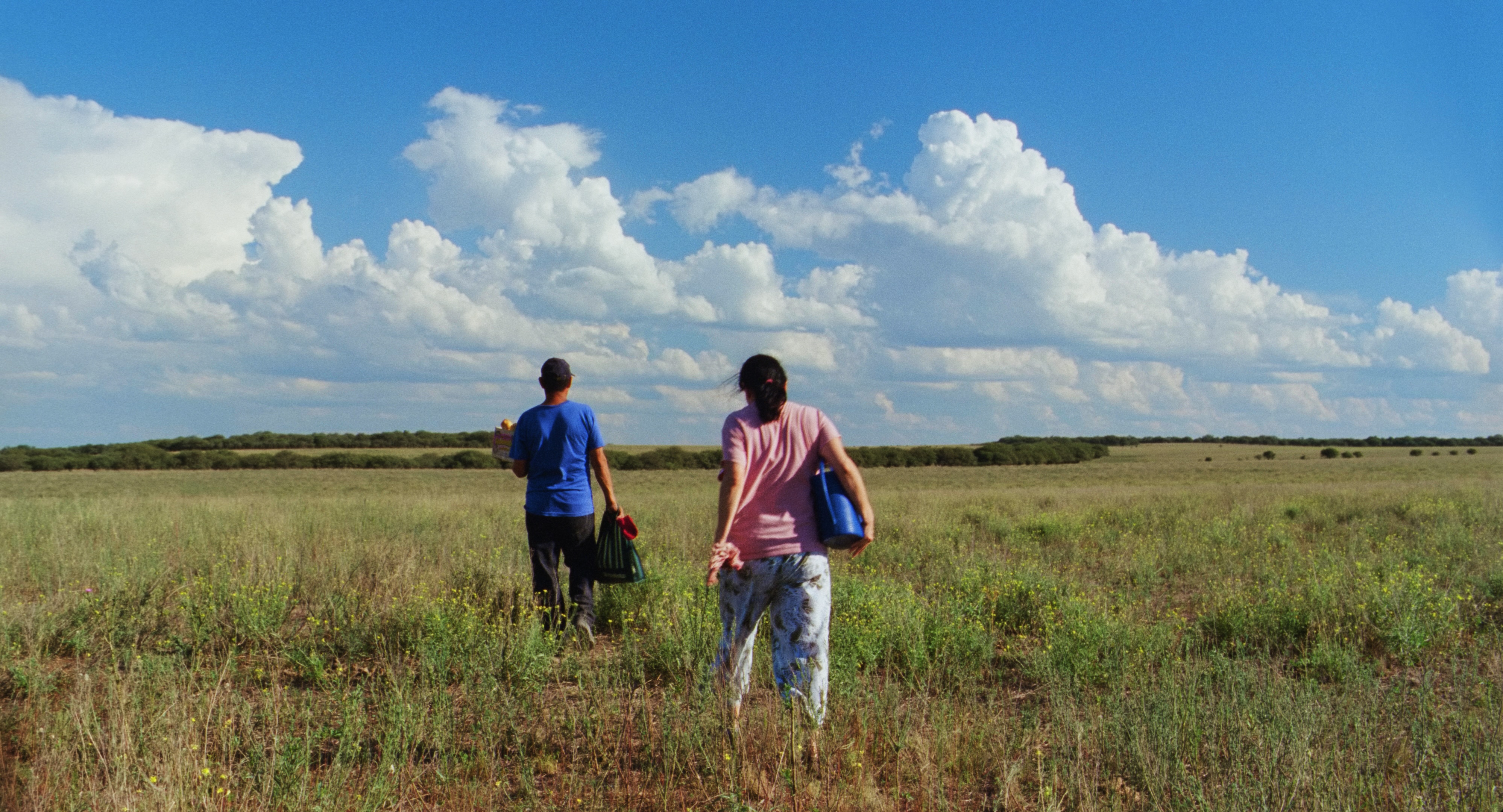
The destruction of the universe occurs when Micaela goes back to Misael’s camp. The first is how space is defined. In both films, the geography that connects Misael’s camp and the rest of the world, even the neighbour that he sells wood to, is ambiguous. In Double Freedom, the two retreat into the camp through a static shot in an almost structuralist tradition, fixating on a landscape divided by the blue sky and the plains, while the two move to the right of the screen and farther and farther away from the camera. In La Libertad, elements within the forest are utilitarian to Misael, serving solely for his enclosed fantasy. Here, Micaela’s presence, described as a fan of the forest, broadens how nature is perceived and how it can be filmed. The trees are no longer there just to be chopped down, a prop to be destroyed and fed into Misael’s minuscule machine of commerce; Micaela, as a stranger, wants to explore them with curiosity. In what is the year’s most beautiful sequence, Micaela explores the forest and finds a kind of spiritual connection that was never sensed with Misael, and we see a close-up that was not possible before.
Another shift occurs in the narrative, especially in Misael’s role within the film’s structure. The film no longer has the circular structure of a “perfect day”(Wim Wenders ™). Micaela’s arrival introduces numerous mental and physical blocks to his lifestyle, with quiet moments of Misael’s face as he contemplates this change. He develops interiority as a character, rather than remaining an alien object for the viewer’s fascination in La Libertad. Once Misael decides to visit Micaela in the hospital, the film jettisons the side-by-side comparison that it invites in the initial segment and, for the first time in the world of “Libertad”, we no longer know how a day will end, where Misael will be, or if we as audience will get to witness the next morning. How do we go to that bonfire once upon a time? What does it mean to pick up a camera and film someone doing the same thing in the same place as 25 years ago? The doubling of freedom seems to be linked inextricably with a loss of innocence.


Leave a Reply