
This week marks the inauguration of Le Cinéma Club’s new 6-week film series, New American Voices. The series is full of fascinating works from new filmmakers that I’ve always been curious about. As the mass-attended blockbuster in multiplexes gets stale, alternative paths of filmmaking and platforms of distribution – the avant-garde filmmaker on YouTube and Vimeo, or those discovering the possibility of narrative in unexpected places (like the group at Omnes films) – emerge to show that creativity is not to be confined by the old ways. I find it important to pay attention to and cover these emerging voices, not to canonize them or to coin them as instant masterpieces, but to keep a watchful eye on their gradual development as filmmakers in the future.
The camera, no matter what, is a cold and lifeless machine whose main purpose is to be pointed towards a filmmaker’s recreated liveliness and record it as it is. The sense of oddity and unease which fills almost the entirety of Lucy Kerr’s Family Portrait is derived from how the camera, whether through varying proximity or movements, becomes entangled with the realities onscreen in ways that do not obey common narrative logic, which in turn makes us, the viewers, whose perspective always aligns with that of the camera, feel adrift.
The film’s primary interest seems to be in distortions, both in form and in narrative. It works under a narrow narrative framework, so much so that you can say there isn’t a narrative at all, but instead one small vignette. On one Sunday, three generations gathered around their family property and arranged to have a portrait taken. The Edgar Allen Poe quote that opens the film, “Through a circle that ever returneth in To the self-same spot”, delivers the main obstacle at the center of the film’s Kafkaesque nightmare: trying to complete a simple task and never finding the simplest straight path to it.
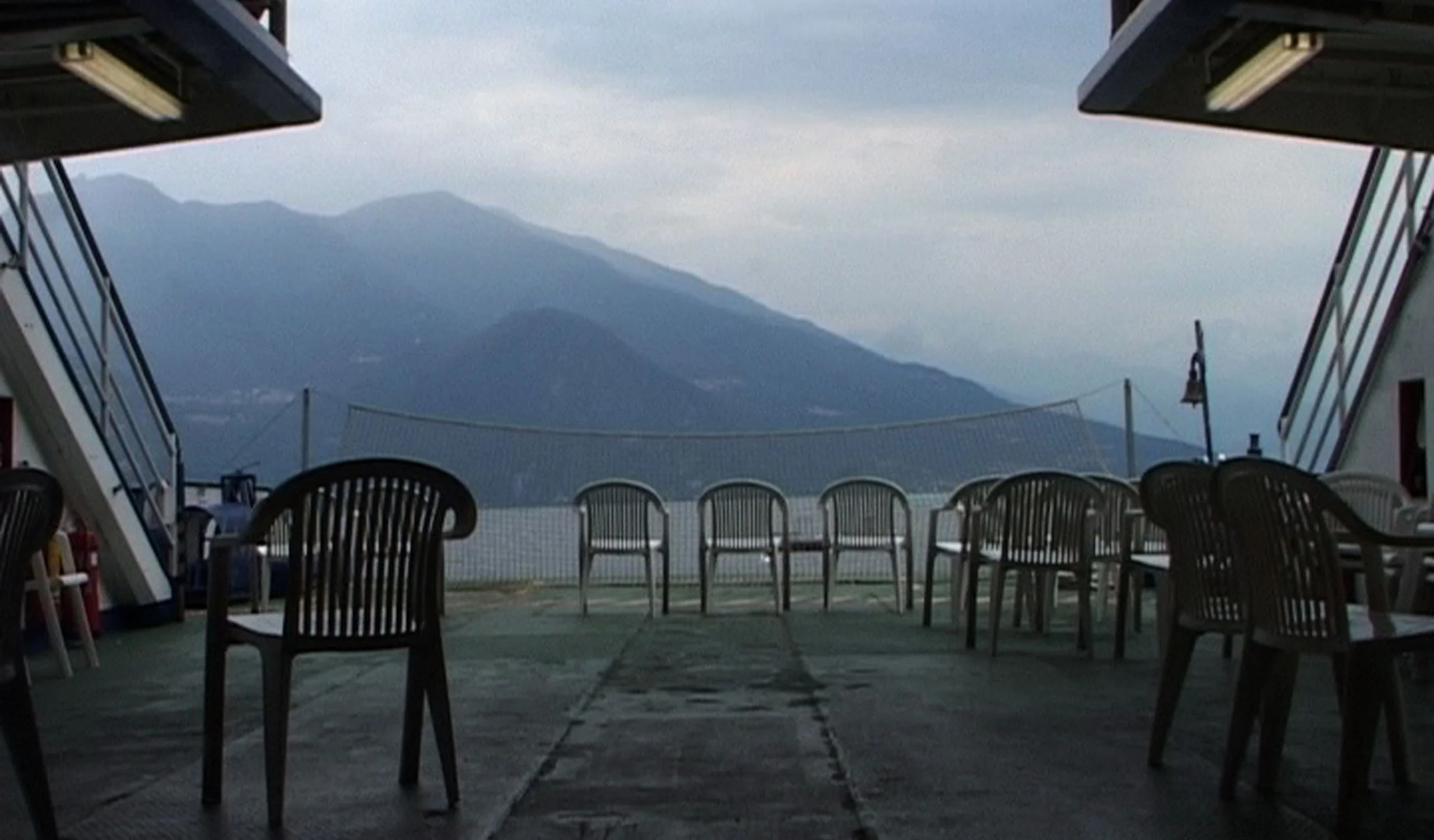
Deragh Campbell stars as the lead, Stacy, who seems to be the only person pushing this objective forward. The other characters are all confined to the setting with her, yet they seem to care only about carrying on inane conversations and never address why they are all gathered there in the first place. The opening sequence represents her struggle formally: a lateral tracking shot that follows Stacy as she drags and pushes her family members to gather around a spot in front of a lake for the family portrait. Here, the tracking shot obeys certain traditional narrative logic: the camera follows the movement of the main subject onscreen. But this logic is subverted by the way the onscreen subject, Stacy, struggles to move everyone else along with her, thereby stalling the tracking shot. The sound in this sequence, muffled by an ominous ambience, adds to the discomfort as well. The sound gradually fades out as the film cuts to the angle where the portrait will be taken. From there, the family seems finally able to gather together, but not quite, never fully satisfied.
In interior scenes, the découpage is almost non-existent in favour of single takes that often introduce a sense of claustrophobia, whether through wide shots that use door frames or kitchen frames, or faces treated with intense close-ups that completely cut off the relationship between the speaker and others. When there is a single shot of a person talking, no reverse shot is provided, so the response they hear comes only from offscreen voices while the camera remains fixed on their face. When Stacy’s Polish boyfriend describes his malaise at his family thinking he is Russian, he is, and remains, lonely. In exterior scenes, claustrophobia transforms into alienation. The camera floats and cuts in a manner that makes itself an element extraneous to the rather mundane conversation being held.
Ultimately, the struggle to identify exactly what these disorienting formal effects amount to left me cold toward the film. The positive here is that the film is not entirely analogous to Stacy’s experience of trying to be responsible and get the whole family in front of the camera (I’m looking at you, If I Had Legs I’d Kick You!). It finds its comfort in allowing its simple premise to succumb to moments that live in stasis of absolute temporal and narrative ambiguity. Personally, I find there to be too many formal signifiers for those individuals’ moments to function as full cinematic organic experiences – someone like Renoir or Rozier would’ve absolutely embodied this quality more- but such a kind of narrative strategy is something I believe worthwhile to dive into.




Leave a Reply