Out of the filmmakers of his generation, there’s no one who has as much faith in the power of mise-en-scène as Jacques Rivette. In the first paragraph of his assessment on Howard Hawks, “The Genius of Howard Hawks”, Rivette claims, “The evidence on the screen is the proof of Howard Hawks’s genius: you only have to watch Monkey Business to know that it is a brilliant film. Some people refuse to admit this, however; they refuse to be satisfied by proof. There can’t be any other reason why they don’t recognize it”.1 The relationship between seeing what’s on the screen and imagining what extends beyond it is pivotal to Rivette’s cinema, where one can sense an overlay of conceptual fascinations and intrigues upon concrete matters. Specifically inside spaces like bars, hotel lobbies, hallways, and castles, the looming tension of conspiratorial dialogues- a trademark of Rivette – is amplified by the weight of body movements that take place during giddy dance number, contemplative conversations, or humorous stalking sessions. Mise-en-scène is what shines so bright in Rivette’s films and gives solid form to many of his idiosyncrasies. But this does not mean he is a formalist, as the scène consists of matters that make cinema cinema: bodies, shadows, light, enclosed spaces, open air, the sun, the moon… No wonder Rivette also said this about Mizoguchi:
But these films — which tells us, in an alien tongue, stories that are completely foreign to our customs and way of life — do talk to us in a familiar language. What language? The only one to which a film-maker should lay claim when all is said and done: the language of mise en scene. For modern artists did not discover African fetishes through a conversion to idols, but because those unusual objects moved them a sculptures. If music is a universal idiom, so too is mise en scene: it is this language, and not Japanese, that has to be learned to understand ‘Mizoguchi’. A language held in common, but here brought to a degree of purity that our Western cinema has known only rarely.2
Through mise-en-scène, one can see all the magical things Rivette was trying to convey, where he commands his private universe.
Noroit and Duelle were intended as the second and third entries in Rivette’s film quartet Scènes de la vie parallèle, which never came to full fruition. I watched Noroit for the first time last year. Having been absolutely floored by Up, Down, Fragile, I expected a similarly whimsical interplay of actors and scenarios, smooth, rhythmic long takes, and a macGuffin that looms over the story. All the formal elements were in fact in Noroit; one could argue that they are all the movie has, but it did not feel whimsical. Obviously, the project was not inspired by the 30s MGM musical, and I simply was not ready to mentally perceive some of the more obtuse choices he made. The film felt like a complete beast of its own, meaning unimpeachable, living by its own rules, and cannot be tamed or domesticated by the commercial expectation of narrative cinema. Today, after a much-needed and overdue revisit, I am able to claim that the first tepid impression of the film was only caused by a lack of sleep on my end and nothing on Rivette’s.
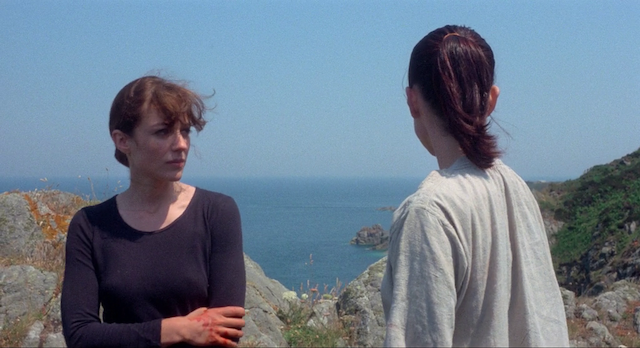
What is Noroit? It’s a revenge drama with a group of pirates. In the opening scene, we see a beautiful scene of the open sea and crashing waves, then the camera pans left, and there’s Geraldine Chaplin sitting on a rock with her dead brother lying on her lap. She announces revenge on Giulia, the leader of the pirate group and owner of the castle, and forms an alliance with Erika, a close confidant of Giulia whose sister was also murdered by her. Chaplin will infiltrate the pirate crew under the name Morag. The story is not complicated at all. It flows linearly, and the keystones of a revenge and a tragedy – gain of trust, alliance, betrayal, death – are all present and remain in their proper thematic interests. This purity is what makes Rivette so brilliant and also his films hard to parse: it’s how he represents these themes solely through the unfolding of sequences onscreen.
Once again, we return to the topic of mise-en-scène; everything amazing about the film can be found in it, and every theme is contained in its universe. There’s the matter of performances and movements of actors that are often theatrical. But the film itself is anything but. The mise-en-scène is structured entirely around the gravitas of the actors and how their movements, either in tandem or in opposition to one another, correspond to a relationship of alliance or antagonism. Rivette stages the totality of an occurrence; circling across rooms, drifting laterally past window frames, not only filming the gesture of a person according to what’s outlined in the script, but everything surrounding that gesture in that moment, complicating our eyes’ perceptions of the scenario because interests for the moment have proliferated from the singular to multiple to abundance. This abundance is precisely due to the so-called theatricality. Sometimes, like when Morag first gains Giulia’s trust by protecting her from an assassination attempt, there’s a kind of delay in the gestures that introduces a vacuum inside the continuous progression, so we no longer see just the action but become aware of the actors performing it. Yet the fourth wall is never broken. In those moments where the relationship between theatre and cinema becomes murky and might even be deemed as camp, the latency formed between the mechanical progression of the story and our increased awareness of the actors’ bodies accentuates our investment in the screen, as Rivette expresses the core of the story while distorting everything extraneous: like what he said about how the immobility of bodies in Gertrud makes them corridor of speeches3, the exaggerated movements of bodies allow for the most concrete expressions of themes.

What about Duelle? It was also released in 1976, two years after Celine and Julie Go Boating. I specifically mentioned that film because it also pulls off a playful relationship with fiction that is entirely outside the film’s scope. The central dynamic of Duelle is about opposition and syncretism, Bulle Ogier and Juliet Berto specifically, one as a goddess of the Sun, the other a goddess of the Moon, are the center of a series of trickeries and magic. One can imagine big-budget Hollywood movies paying for millions of special effects for those high concepts. Rivette doesn’t need that; he only needs Bulle and Juliet and has them wear a bunch of extravagant costumes that transform into those femme fatales in Hollywood noir.
For the majority of the film, we don’t know what is actually happening. Each scene are centred on the immediate interactions and opposition between the two in conversation onscreen, instead of following a larger narrative at hand. In this sense, Duelle can be described as the direct opposite of Noroit. Shot-reverse-shot and tracking shots around hotel room, dance floor, underground casino, all locations frequented by those femme fatales and the men who fall in the palm of their hands. Rivette films the magnetism and gravitational laws of attraction that always manage to bring two people, two bodies, into orbit around each other. The fantastic and the conspiratorial are looming around – once again, we have a series of deaths and a diamond as the macguffin that both goddesses are searching for, but will not resort to symbolic explanations for those scenes.
When the actual objective of a scene becomes clear, Rivette’s way of representing the metaphysical through cuts and staging remains magical. Specifically, the two mirroring duels close to the end, one set in a dance hall of mirrors and the other set in a hallway, the duel of light and shadows. One gets the sense that Rivette’s sense of play in Duelle is his desire to dance freely in the hall of cinema, which means for the quartet of females to enact different scenarios without being solidly bound by a concrete narrative path and risk losing the dynamicism of physical spaces that serve as stages for people to feel alive: the dancing floor filled with couples, the underground casino seating tables of unnamed men, the nighttime aquarium of secret exchange…
Rivette believes in cinema, so he limits himself to his fundamental interests. His simplicity is often mistaken for over-complexity because of the demand for stricter narrative progressions and for simpler relationship symbolism and plot. Everything is in front of you, like the band that always accompanies the pirate crew or Jean Wiener playing the piano in Duelle, and there’s no way to extract them from the synthesis of form. The cinema has a built-in beginning and an end, both of which often correlate with a story, but they absolutely don’t have to. Colourful images can suddenly be interrupted by images in black-and-white, but the internal clock of cinema does not pause for a second. What is truly riveting about the two Rivettes is the bodies. At the end of Noroit, plenty of deaths occur, yet they are not as frightful as the end of Duelle, where our narrative expectations of seeing a body onscreen are challenged. We hear the sound of trains, which is the sound of the arrival of cinema, but Rivette’s cinema takes a leap through his faith in the concrete and evanesces in its absence.
- Rivette, Jacques, “The Genius of Howard Hawks” (1953), Originally appeared in Cahiers du cinema 23 (May 1953); p. 16-23. Reprinted from Cahiers du cinema: The 1950s, ed. Jim Hillier (Harvard, 1985). Translated by Russell Campbell and Marvin Pister, adapted from a translation by Adrian Brine ↩︎
- Rivette, Jacques, “Mizoguchi Viewed from Here” (1958), Originally appeared in Cahiers du cinema 81 (March 1958); p. 28-32. Reprinted from Cahiers du cinema: The 1950s, ed. Jim Hillier (Harvard, 1985). Translated by Liz Heron. ↩︎
- Jean Narboni, Sylvie Pierre and Jacques Rivette, “Montage,” In: Jacques Rivette: Texts and Interviews (London: BFI, 1977). Originally published in Cahiers du cinéma, nr. 210, March 1969. Translated by Tom Milne. Excerpted in Sabzian ↩︎



Leave a Reply